Is Searching on ChatGPT or Google Illegal in Pakistan? NCCIA and PECA Law Explained

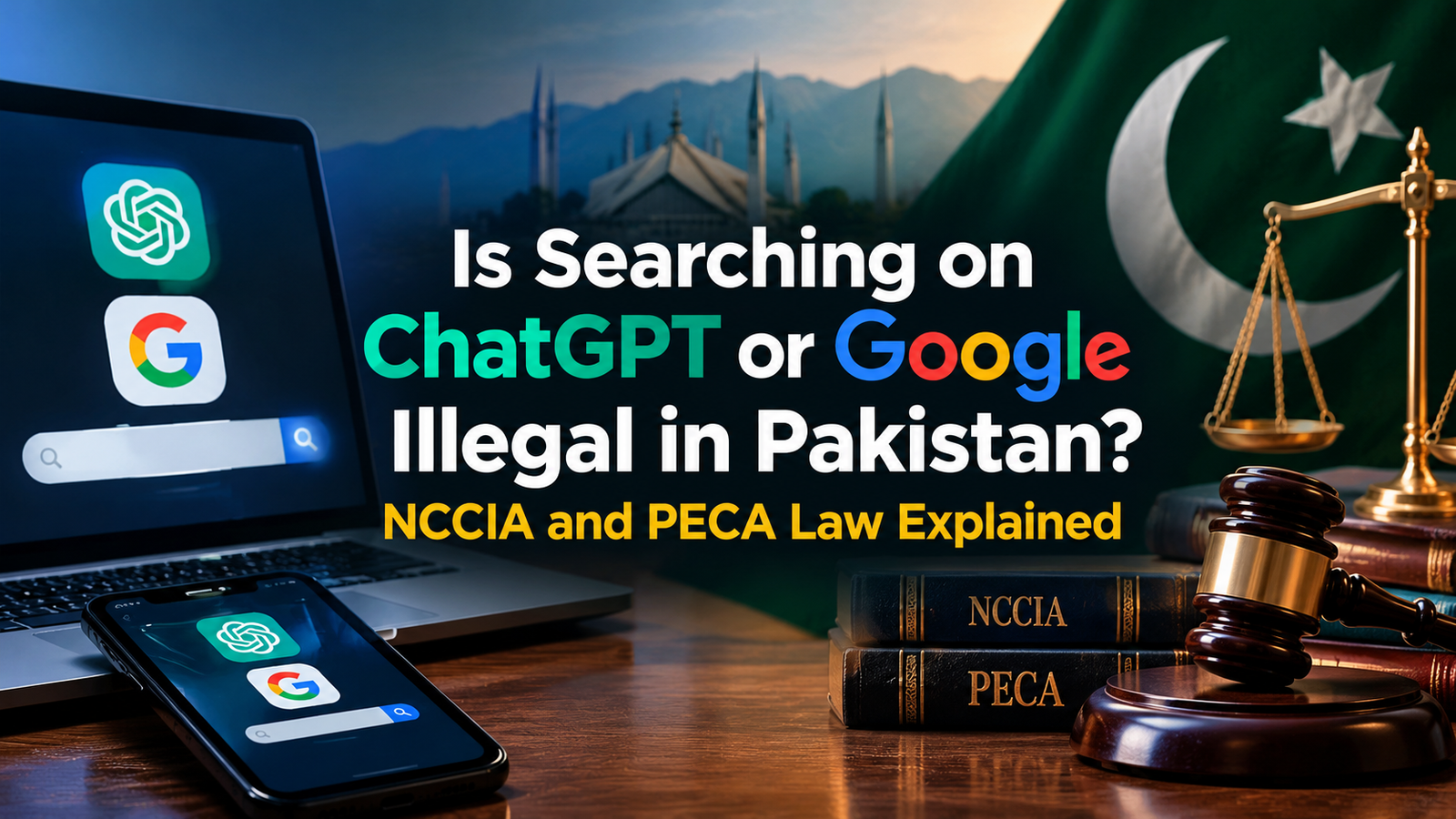
Using ChatGPT or Google is not a crime in Pakistan, but using AI to deceive, impersonate or harm someone can be. As AI becomes part of millions of people’s daily lives, many are asking the same uneasy question: Can an AI search land me in trouble with the NCCIA?
The National Cyber Crime Investigation Agency (NCCIA) has replaced the FIA’s cyber wing and recently activated cyber-patrolling units nationwide. Jeelani Law Empire, a law firm based in Karachi for NCCIA cases, explains what the Prevention of Electronic Crimes Act (PECA) really means, what kind of crimes are defined under PECA, and what you should do if you receive a notice from the police.
Is Searching Online or Asking an AI a Crime in Pakistan?
Using a search engine or asking an AI chat bot a question is not a PECA offense. There is no section which makes search an offense in itself which we know of. The law is directed at the individual’s actions, i.e. what a person does, makes, possesses or disseminates.
That distinction matters. Questions like: “Explain the law,” “What’s happening in the news,” or “What are the health risks for smoking?” are normal usage. The legal peril starts once AI is employed to create a faux document, intimidate a person or spread a fake story.
The lesson here: If an investigation begins and you are lawfully seized, your browsing history and AI chats may be evidence. Then a seemingly harmless search can be interpreted as evidence of intent depending on what you did after the search. Evaluate each prompt for its intent and for its results.
When AI Use Becomes a PECA Offence
When the output of AI is used to deceive, impersonate, harass or spread lies, its use becomes criminal. While AI is not mentioned in PECA, the offences cover AI-generated content where the elements are met. These are the segments with which people have the highest frequency of interaction:
- Electronic forgery (Section 13): Documents created by AI, screenshots or edited images used as authentic documents with malicious intent to cause damage or obtain an unlawful advantage.
- Electronic fraud (Section 14): to mislead a person to gain an advantage for oneself through the use of electronic devices. Up to 2 years in prison and a fine of up to Rs 10 million.
- Misuse of identity (Section 16): use of another person’s name, photo, CNIC or other identity information without permission, such as fake profiles. A fine of up to Rs 5 million or imprisonment for up to 3 years.
- Cyberstalking (Section 24): harass, intimidate or coerce someone online (including sharing images without consent). The punishment is up to 3 years or a fine of up to Rs 1 million, with harsher punishment if the perpetrator is a minor.
- False information (Section 26A): intentionally spreading false information likely to cause fear, panic or unrest. Up to 3 years and/or a fine of up to Rs 2 million.
- Dignity and Modesty (Sections 20 and 21): content that injures a person’s dignity and modesty, such as fake videos, voices or images of real persons created by AI.
This is real-world and practical. A journalist recently wrote to the NCCIA about an AI image and a fake voice accusing him of false allegations.
Content That Is Dangerous to Possess or Share, Whatever the Tool
Not all information is safe to consume, and AI doesn’t make it safer. It is a crime to produce, distribute or possess sexual material about children, as Section 22 states, and courts have handed down heavy penalties, such as a Rs 1.2 million fine and seven years’ imprisonment in one reported case.
The cyber terrorist provisions (Section 10) of the Act are among the most stringent. One of the most severe provisions of the Act is the cyber terrorist one (Section 10). It’s not a loophole to create such content with AI. Don’t forward it if you see it. Report to the NCCIA helpline 1799.
How NCCIA Takes Action: From Complaint to Seizure
The procedure for NCCIA action typically begins with a complaint or with their own monitoring procedures, then progresses to notice and inquiry and, ultimately, arrest or search in serious cases. The usual route is as follows:
- Complaint or monitoring. A victim contacts the helpline (1799) or reports in person, or Cyber-patrolling units of the agency identify the content.
- Notice or summons. Possible questioning or data provision.
- Warrant for search and seizure. Generally, a judicial warrant is needed first, and then it must be a Gazetted officer of the agency.
- Data directions. PECA can be used to keep data safe, and the data can be compelled to be released through a court warrant.
- Registration of cases and trials. If an offense is found, a case is registered and goes before the court.
An exception for the most serious offences exists, but there is a limit. A Gazetted officer can search without a warrant in a Section 10 matter where it would be likely to destroy data, but they must notify the court within 24 hours. The NCCIA has exclusive powers under the Act since the amendment in 2025 in Section 30 of the Act.
Can NCCIA Check Your Search History and AI Chats?
The NCCIA is only able to look at your searches and AI chats with a warrant, typically in the context of an inquiry or case, and generally at only one point in time per case. Unlawful search of a cell phone is subject to challenge. However, the browser history, chat logs and files of a lawfully seized device can be explored as digital evidence once it has been seized.
There’s some protection with PECA. If a person authorised to access the data has broken the confidentiality of the data, it is an offense under Section 41 of the Act, and there is an independent forensic laboratory to the investigating Officer.
Here are two points to consider: Avoid deleting data after it has been discovered that there is a complaint, as this may appear to be destroying evidence. Request and view the warrant or notice, and consult with a legal representative prior to making statements or accessing the scene.
Your Rights If You Receive an NCCIA Notice in Pakistan
A “notice” is not a conviction. It is a request for an explanation or information, and your rights under the law are in effect from the first day.
- Request the notice in writing and double-check the nature of the offense and which section it refers to.
- Be sure to identify the officer and (in the event of a search) request a copy of the warrant.
- Avoid ignoring the notice. One day of missing can only make things worse.
- Don’t give any written or recorded statement without consulting a lawyer first.
- Many offences relating to harassment, including Section 16, 20 and 24, are said to be ‘bailable’ offences, but bail must be dealt with correctly.
- The PECA Investigation Rules 2018 prohibit disclosure of the victim’s identity in the following cases: modesty/dignity cases.
How to Choose the Best NCCIA Lawyer in Pakistan
The most effective NCCIA attorney is the one who is familiar with the procedure of PECA and is quick to respond. NCCIA cases are moving rapidly, and initial action (including responding to a notice) can often have a significant impact on the resolution. Seek them out for the following attributes:
- PECA and NCCIA experience: regular practice in cybercrime notices, inquiries and bail applications.
- Court access: ability to appear before magistrates, sessions courts and the High Court.
- Quick response: a person you can contact the same day you receive a notice.
- Clear advice – a straightforward statement of the charge, likely steps and fee – no guarantees of results.
At Jeelani Law Empire, our advocates handle NCCIA and FIA cybercrime notices, bail applications and related criminal matters in Karachi. Read more on our FIA and cybercrime lawyer and criminal lawyer pages.
Six Safe Habits for Using AI in Pakistan
- Don’t use AI to mimic another person’s face, voice or writing without their permission.
- Never make or post fake documents, receipts or screenshots.
- Verify facts before publishing AI-generated news or statements.
- Do not expose CNIC details or private information to public AI tools.
- Avoid spreading abusive and suspicious messages. Report it instead.
- In case you are a victim: Save screenshots, links and dates before anything is deleted.
Final points: AI is a tool to be used freely, but never to deceive or cause harm.
It is not a crime to ask questions of AI or a search engine in Pakistan. It can be deceptive, impersonating it, harassing and spreading falsehoods. PECA considers your actions and your purpose, and the NCCIA is now on the streets. If you understand the law and the extent of the agency’s authority, you are in a better position, either side.
Seek guidance early if you’ve been issued an NCCIA notice or arrested on a PECA, or if you’ve been targeted with AI deepfakes or online blackmail. Call Jeelani Law Empire, your trusted advocacy service in Karachi, on WhatsApp at +92 310 0805777 or book an appointment on our website.