


Divorce Legal Notice Format: How to Write One

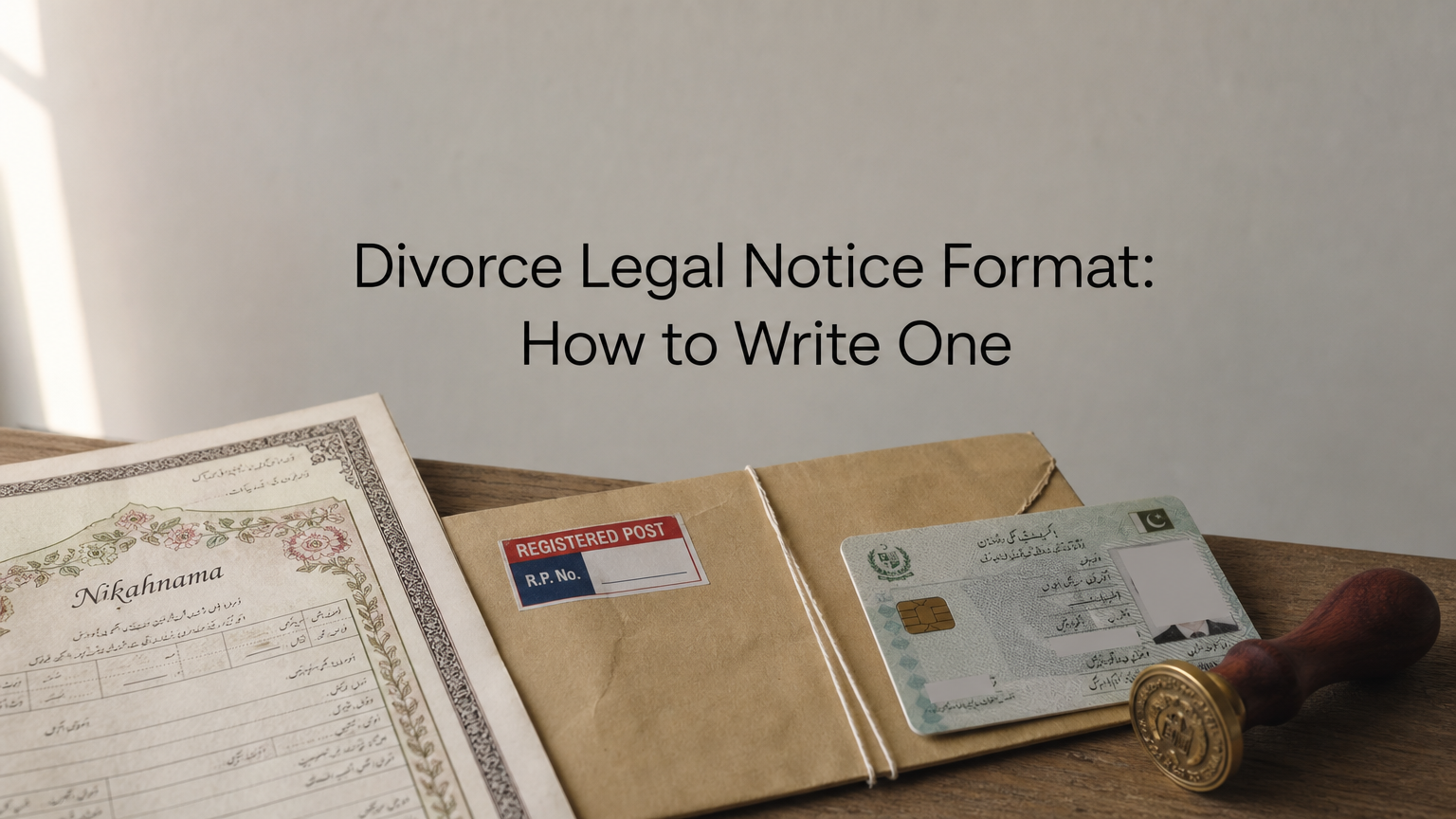
Searching for a divorce legal notice format usually means one thing: you’re at the point where talking things out hasn’t worked, and you need something formal in writing. Whether you’re a husband preparing to notify his wife or a wife drafting a notice to her husband, the wording matters. A poorly drafted notice can weaken your position later in court, or worse, get dismissed as invalid altogether.
This guide gives you a working legal notice divorce format you can actually adapt, along with a breakdown of what each section needs to say and why. We’ll cover how a legal notice to wife format differs from a legal notice from wife to husband format, what details courts expect to see, and where people commonly go wrong when they copy a template off the internet without adjusting it to their facts.
At Jeelani Law Empire, we draft these notices for clients across Karachi and overseas every week, so we know which phrasing holds up and which invites unnecessary delays. By the end of this article, you’ll understand exactly how to structure your notice, what to include, and when it’s worth having an advocate review it before you send it.
What is a divorce legal notice and when you need one
A divorce legal notice is a formal written communication, sent through an advocate, that puts your spouse on official record that you intend to end the marriage or that you’re raising specific grievances that could lead to divorce proceedings, and it works much like any other notice in its meaning and purpose. It’s not the divorce itself. Think of it as the opening move that documents your position, your grounds, and your intent before you approach a family court. Under Pakistani family law, this step often precedes filing for Khula, dissolution of marriage, or a response to desertion, cruelty, or non-maintenance claims, so it helps to understand the wider legal procedure for divorce in Pakistan first.
Courts in Karachi and across Sindh generally expect to see that reasonable notice was given before litigation started, especially in cases involving maintenance, dower (haq mehr), or custody. Skipping this step doesn’t always block your case, but it weakens your credibility with the judge and gives the other side room to argue you acted in bad faith. A legal divorce notice format that’s properly drafted and dispatched creates a paper trail that protects you later, whether you’re the one filing for divorce or defending against baseless accusations.
A divorce legal notice that’s properly drafted does more than announce your intent, it protects your legal position months before you ever step into a courtroom.
Common situations that call for one
You’ll typically need a divorce legal notice in these scenarios:
- Husband to wife: notifying pronouncement of talaq and initiating the Union Council arbitration process required under the Muslim Family Laws Ordinance
- Wife to husband: demanding Khula, unpaid dower, maintenance, or return of belongings before filing suit
- Custody disputes: putting the other parent on notice regarding visitation or custody intentions
- Domestic violence or cruelty: documenting incidents formally before seeking protective court orders
- Property or dowry recovery: demanding return of jointly owned assets or dowry items ahead of a civil suit
Husband’s notice versus wife’s notice
The core structure stays the same, but the content shifts depending on who’s sending it. A legal notice to wife format usually centers on the talaq pronouncement, the date it takes effect, and instructions regarding the iddat period and arbitration council notification. A legal notice from wife to husband format more often addresses grievances first (cruelty, non-maintenance, second marriage without consent) and then states the intention to pursue Khula if reconciliation fails, which follows the Khula procedure and women’s rights in Pakistan.
| Element | Husband to Wife | Wife to Husband |
|---|---|---|
| Primary purpose | Announce talaq | State grievances, request Khula |
| Key legal reference | Muslim Family Laws Ordinance, 1961 | Dissolution of Muslim Marriages Act, 1939 |
| Common demands | Notify Union Council | Return of dower, maintenance arrears |
| Typical response window | 90 days (iddat) | 15-30 days before filing suit |
Without this document, disputes over maintenance, custody, or dower become harder to prove in court, since judges look for evidence that the other party had fair warning and a chance to respond. That’s why getting the format right from the start saves you months of procedural back and forth later.
Step 1. Gather the marriage and dispute details
Before you even open a template, sit down and collect every fact that will end up in the notice. A divorce legal notice format only works if the details behind it are accurate and complete, since courts cross-check dates, addresses, and CNIC numbers against your marriage certificate (Nikahnama) and other records from your marriage registration in Karachi. Missing or mismatched information is one of the most common reasons a notice gets challenged or ignored by the receiving party’s lawyer.

What to have on hand
Start with the paperwork that proves the marriage exists and identifies both parties correctly:
- Nikahnama with registration number, date, and the Union Council or NADRA union council code
- CNIC copies of both spouses, current and permanent addresses
- Dower (haq mehr) details, whether prompt or deferred, and whether it was paid
- Children’s information, including birth certificates if custody or maintenance is part of the dispute
- Evidence of grievances, such as messages, medical reports, police complaints, or witness names if cruelty or desertion is alleged
- Any prior communication, including WhatsApp messages or emails where reconciliation was attempted
A notice built on verified facts moves faster through court than one built on assumptions.
Collecting this before drafting saves you from sending a corrected notice later, which resets timelines and gives the other side an excuse to claim confusion or bad faith.
Confirm jurisdiction and timeline
Jurisdiction matters as much as content. Confirm which Union Council or Family Court has authority based on where the marriage was registered or where the couple last resided together, since a legal notice format for divorce sent to the wrong forum can delay arbitration by weeks. Pin down key dates too: when the marriage took place, when the dispute started, and any deadlines tied to iddat or prior legal correspondence.
Once you have this information organized, you’re ready to plug it into the actual structure of the notice. If you’re unsure whether your documentation is complete, a quick consultation with an advocate at this stage catches gaps before they become problems in court.
Step 2. Follow the correct divorce legal notice format
Once your facts are in order, structure matters more than length. Every divorce legal notice format follows a predictable skeleton: sender and recipient details, a statement of facts, the legal grounds, your demand or intention, and a response deadline, the same skeleton behind the standard legal notice format Karachi individuals and businesses use. Advocates in Karachi keep this structure tight on purpose, since a rambling notice buries the actual legal claim and gives the opposing lawyer room to nitpick technicalities instead of addressing the substance.
A notice that follows a clear structure gets read carefully; one that rambles gets picked apart.
The core sections every notice needs
Build the document in this order, regardless of whether you’re using a legal notice to wife format or a legal notice from wife to husband format:
- Heading and reference stating it’s a legal notice, with date and advocate’s letterhead
- Parties involved, full names, CNIC numbers, and addresses of sender and recipient
- Marriage details, Nikahnama number, date, and place of registration
- Statement of facts, a chronological account of the dispute or grounds for divorce
- Legal grounds cited, referencing the relevant ordinance or act
- Demand or declaration, whether that’s pronouncement of talaq, request for Khula, or return of dower
- Response deadline, typically 15 to 30 days depending on the matter
- Advocate’s signature and contact details
A basic template you can adapt
Here’s a simplified skeleton. Don’t send this as-is; it needs your facts, correct legal citations, and an advocate’s review before dispatch, which is where professional notice drafting and service earns its cost.
LEGAL NOTICE

Date: [DD/MM/YYYY]

To: [Recipient's full name, CNIC, address]
From: [Sender's full name, CNIC, address], through [Advocate's name and office]

Subject: Legal Notice regarding [Divorce/Khula/Maintenance]

Sir/Madam,

Under instructions from my client, [sender's name], I hereby serve you
this legal notice on the following facts:

1. That my client was married to you on [date] vide Nikahnama
   registered under [Union Council/registration number].
2. That [state facts and grievances chronologically].
3. That in view of the above, my client hereby [pronounces talaq /
   intends to seek Khula / demands return of dower and maintenance].

You are hereby called upon to respond within [15/30/90] days from
receipt of this notice, failing which my client shall be constrained
to initiate proceedings before the competent Family Court.

[Advocate's name, seal, and signature]
Getting each field filled correctly, rather than copying a generic legal notice divorce format word for word, is what separates a notice that holds up from one that gets thrown out on a technicality.
Step 3. Have an advocate draft and review the notice
Templates get you 80% of the way there, but the remaining 20% is where cases get won or lost, which is the real answer to whether you need a lawyer to send a notice. An advocate’s review catches wording that sounds fine to a layperson but reads as ambiguous or legally unenforceable to a family court judge. In Karachi, notices drafted without a lawyer’s letterhead are sometimes disregarded entirely by the Union Council or the receiving spouse’s counsel, since there’s no accountable legal professional standing behind the claims. Getting this divorce legal notice format checked before it leaves your hands is the cheapest insurance you’ll buy in the entire process.

A notice without an advocate’s signature often gets treated as a letter, not a legal document.
What an advocate actually checks
Beyond fixing grammar, a competent advocate reviews the notice for substance. Specifically, they confirm:
- Correct legal citations, matching the right ordinance or act to your specific grounds
- Accurate jurisdiction, so the notice goes to the Union Council or court that actually has authority
- Realistic demands, avoiding claims that overreach and invite counter-litigation
- Proper service method, registered post, courier with tracking, or process server, depending on what the forum requires
- Consistency with future filings, since contradictions between the notice and a later court petition damage credibility
Why self-drafted notices backfire
Self-drafted notices commonly fail because they either overstate facts the sender can’t prove or omit statutory language the receiving lawyer expects to see. Without that phrasing, an opposing advocate can argue the notice never properly triggered the response period, which restarts your timeline from zero. Your advocate also verifies that dates, CNIC numbers, and Nikahnama details match official records exactly, since a single transposed digit has been enough to get a notice challenged in Karachi family courts.
Youwill also want a second set of eyes on tone. A notice that reads as aggressive or accusatory rather than factual can complicate reconciliation efforts the court may later require. At Jeelani Law Empire, we draft and review notices for exactly this reason, so clients don’t discover a defect only after the 30-day window has already closed.
Step 4. Send the notice and prepare for a response
Drafting the notice correctly means nothing if it doesn’t reach your spouse through a method that holds up in court. Sending the notice the correct way creates the proof of service that judges rely on when deciding whether the response period actually started. Skipping registered channels in favor of a casual text message or hand-delivered letter is one of the fastest ways to have an otherwise solid notice challenged later.

Choosing a service method that courts accept
Generally, advocates in Karachi rely on one of these methods, often combining two for extra protection:
- Registered post with acknowledgment due (AD), giving you a signed receipt as proof of delivery
- Courier service with tracking, useful when the recipient is overseas or in another province
- Process server services through the court or Union Council, typically used when the recipient is avoiding delivery
- Publication in a newspaper, reserved for cases where the recipient’s address is unknown or delivery has repeatedly failed
Proof of delivery matters as much as the wording inside the notice itself.
What to expect once it’s delivered
Once delivered, the clock starts on whatever response window your notice specified, usually between 15 and 90 days depending on the matter. Recipients typically respond in one of three ways: agreeing to the terms, disputing the facts through their own advocate, or ignoring the notice entirely. Silence doesn’t stall your case; it actually strengthens your position when you eventually file for divorce in Karachi before the Family Court, since it demonstrates you gave fair opportunity to respond.
Throughout this window, keep every piece of correspondence, delivery receipts, and any reply you receive, since your advocate will need this file when preparing the court petition. Preparing for a non-response in advance, rather than waiting until day 31 to figure out next steps, keeps your case moving without unnecessary delays. If you haven’t heard back and the deadline has passed, your advocate at Jeelani Law Empire can move directly to drafting the court filing using the notice and its proof of service as your foundation.
Getting your divorce notice right
Getting the divorce legal notice format right isn’t about finding the perfect template online. It’s about pairing accurate facts, correct legal citations, and proper service with an advocate who knows how Karachi’s family courts actually treat these documents. Skip any one of those pieces and you risk a notice that gets dismissed as a technicality rather than taken seriously as your opening legal move.
Remember the sequence: gather your marriage and dispute details, follow a structure that covers every required section, get it reviewed before it leaves your hands, and send it through a method that proves delivery. Do that, and you walk into any future court proceeding with a paper trail that backs your position instead of undermining it.
If you’re drafting a notice to a husband or wife and want it checked before it goes out, speak to the experienced advocates and legal consultants at Jeelani Law Empire before you send anything. A short consultation now can save you months of delay later.