


Legal Notice Format for Recovery of Money: What to Include

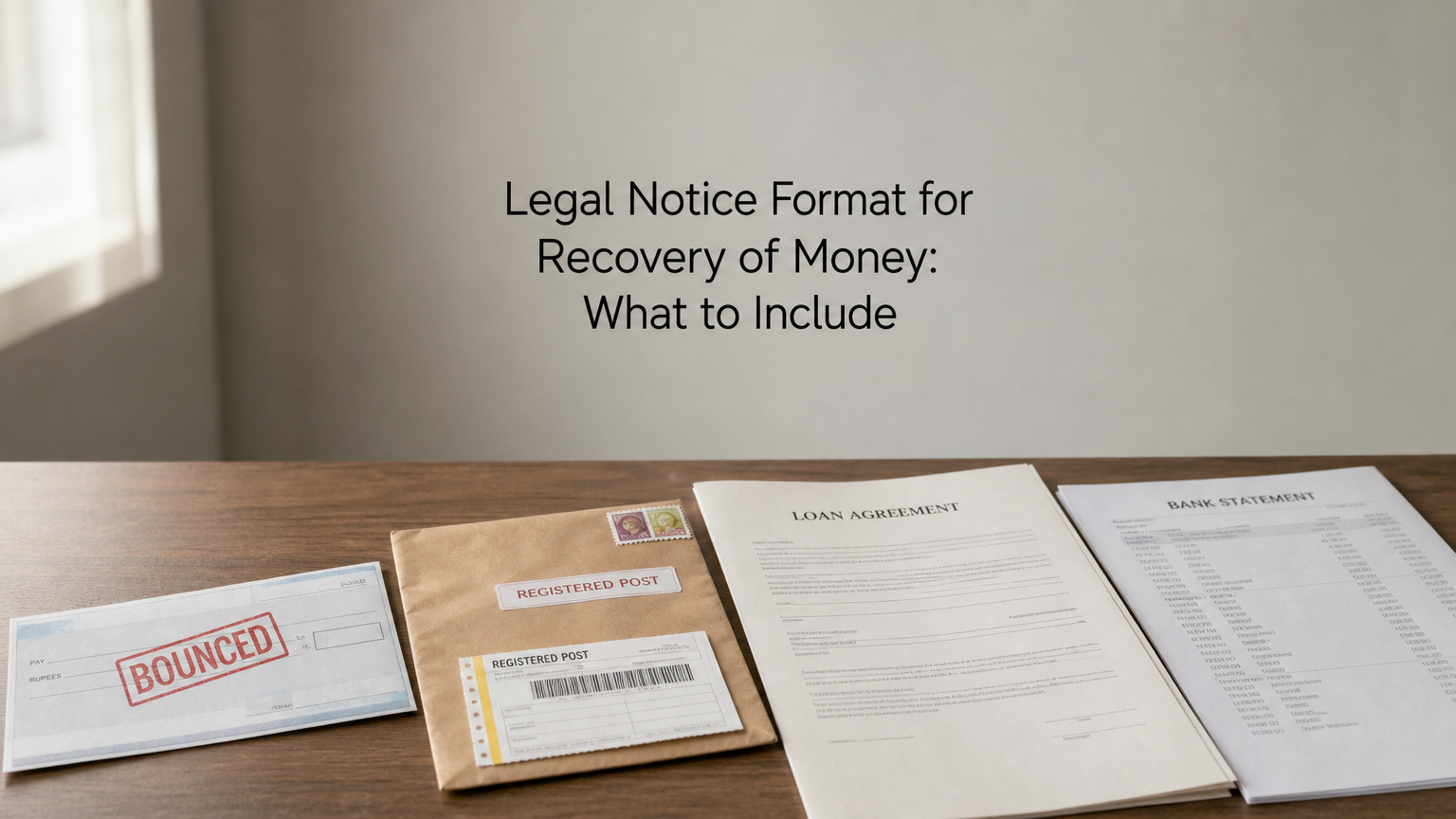
Someone owes you money and keeps dodging your calls. Maybe it’s a friend who borrowed cash and went quiet, or a company that never paid an invoice. Before you head to court, Pakistani law usually requires you to send a formal demand first, and that’s exactly where a proper legal notice format for recovery of money matters. Get the wording wrong, and you hand the other side an easy excuse to ignore you or challenge the notice later.
A recovery notice isn’t a casual letter. It needs specific details: the amount owed, the transaction history, a clear deadline for repayment, and a statement of the legal action you’ll pursue if payment doesn’t arrive. Whether you’re chasing a debt from a friend or a corporate client, the payment legal notice format follows a similar structure, though the tone and legal references shift depending on who you’re addressing.
In this article, we’ll break down exactly what belongs in your notice, walk through the format section by section, and point out the mistakes that weaken a notice before it even reaches the debtor. If you’d rather have a Karachi advocate draft and send it for you, our team at Jeelani Law Empire handles legal notice drafting for money recovery daily.
Why a legal notice matters before recovering money
Money recovery cases in Pakistan almost always move faster and land stronger when a legal notice for recovery of money goes out first. Courts expect to see that you gave the debtor a fair chance to settle before you dragged them into litigation. Skip this step, and a judge may ask why you rushed to file a suit instead of trying to resolve things directly. That question alone can stall your case for months.

The legal groundwork behind the notice
Pakistani law doesn’t leave this to guesswork in every situation. If you’re recovering money through a bounced cheque, Section 138 of the Negotiable Instruments Ordinance, 1881 requires you to send a written demand within 30 days of the cheque returning unpaid, and the debtor gets 15 days to pay before you can file a criminal complaint. Miss that window, and you lose the right to proceed under that section entirely. For ordinary debts, contracts, and unpaid invoices, there’s no single statute that forces you to send a notice, but the Code of Civil Procedure and standard court practice both favor plaintiffs who can show they attempted an amicable resolution first. A format of legal notice for recovery of payment that references the specific agreement, invoice, or cheque number gives your case a documented starting point that a judge can follow.
A legal notice isn’t a formality, it’s the paper trail that convinces a court you tried the reasonable route before the expensive one.
What the notice actually does for your position
Sending a legal notice in Karachi does more than warn the debtor. It builds a record. Once you’ve sent a properly worded legal notice format for money recovery, you’ve created dated, written proof of three things: what’s owed, when you asked for it, and what you said would happen if payment didn’t come. That record becomes evidence if the matter ends up in court. It also puts pressure on the debtor immediately, and while creditors often ask whether you need a lawyer to send a legal notice, many people who ignore phone calls and texts respond the moment a notice arrives on official letterhead referencing an advocate. In our experience as a debt recovery lawyer in Karachi handling recovery matters out of our Clifton and New Chali offices, roughly a third of clients see payment or a serious settlement offer within two weeks of the notice going out, long before any suit gets filed.
Here’s what a notice typically accomplishes before you ever set foot in court:
- Establishes a paper trail showing the debtor was formally informed of the amount owed and the deadline to pay
- Triggers a legal deadline, especially in cheque dishonor cases where the 30-day and 15-day windows under the Negotiable Instruments Ordinance apply
- Opens the door to settlement without litigation costs, which many debtors prefer once they realize you’re serious
- Strengthens your suit if the matter does go to court, since judges view a documented demand favorably
- Signals professionalism, particularly when the notice comes from an advocate rather than the individual creditor
The cost of skipping it
Think about what happens if you file a suit for recovery without ever sending a notice. The defendant’s lawyer can argue you never gave their client a chance to pay voluntarily, and while this rarely gets a case dismissed outright, it can affect how the court views costs, timelines, and even settlement negotiations later. Worse, in cheque bounce matters specifically, filing without the mandatory notice period can get your complaint thrown out on a technicality, forcing you to start the entire process over while the debtor gains months of extra time. That’s a real cost, not a theoretical one, and it’s the exact reason experienced advocates never skip this step regardless of how small the debt seems. A well-drafted notice costs you a fraction of what a delayed or dismissed case will, both in lawyer fees in Karachi and in the time your money sits unpaid.
How to draft a legal notice for recovery of money
Drafting a legal notice format for recovery of money starts long before you open a Word document. You need to know exactly what you’re claiming, back it with proof, and present it in language that reads as firm and factual rather than emotional. A notice that rambles about how the friendship soured or how frustrated you feel weakens your position. Courts and debtors alike respond to notices that read like they came from someone who has already thought through the legal consequences of nonpayment.
Gather your documentation before writing
Before you draft a single sentence, collect everything that proves the debt exists. This step matters more than the wording itself, because a notice built on solid documentation is nearly impossible to dispute later.
- Loan agreement, promissory note, or WhatsApp/email confirmation of the amount lent or owed
- Invoice numbers and payment terms if this involves a business transaction
- Bank statements or transfer receipts showing when money changed hands
- Cheque details including number, date, and bank name if a cheque bounced
- Prior correspondence where you or your lawyer already asked for payment informally
Even a legal notice format for recovery of money from friend benefits from this level of detail. Friendships don’t excuse debtors from documentation requirements once the matter reaches a lawyer’s desk.
Structure the notice logically
Every strong notice follows the same skeleton as the standard legal notice format in Pakistan regardless of who’s receiving it: sender and recipient details, a clear statement of facts, the specific amount claimed, the legal basis for the claim, a deadline, and the consequences of non-payment. Skipping any one of these sections gives the recipient room to argue the notice was vague or incomplete. A format of legal notice for recovery of money that jumps straight to threats without laying out the facts first tends to look unprofessional and can actually undermine your credibility if a judge reads it later.
A notice that states the facts plainly and backs them with documents does more work than one that just sounds angry.
Set a firm but reasonable deadline
Most recovery notices drafted to the legal notice format Karachi courts expect give the debtor between 7 and 15 days to respond, depending on the amount and the relationship. Cheque dishonor cases have a fixed 15-day window under the Negotiable Instruments Ordinance, so don’t shorten or extend that period arbitrarily. For ordinary debts, 10 days is usually enough to signal urgency without looking unreasonable if the matter later goes before a judge. Whatever deadline you choose, state it as a specific date rather than a vague phrase like "immediately" or "as soon as possible," since specific dates hold up far better as evidence.
Sample legal notice format for recovery of money
Seeing an actual template makes the structure click faster than any explanation. Below is a working sample legal notice format for recovery of money that you can adapt for most straightforward debt situations, whether the amount came from a loan, an unpaid invoice, or a bounced cheque. Swap in your own facts, dates, and figures, but keep the sequence of sections intact since that order is what gives the notice its legal weight.

A notice that names the amount, the deadline, and the consequence in three clear lines rarely gets misread by anyone, including a judge.
The template you can adapt
Use this as your starting draft. It’s written for a straightforward personal loan, but the same skeleton works for invoices and other unpaid amounts with minor wording changes.
LEGAL NOTICE

Date: [Insert Date]

To:
[Recipient's Full Name]
[Recipient's Address]

From:
[Your Name / Advocate's Name and Chamber Address]
On behalf of: [Your Name]

Subject: Legal Notice for Recovery of Rs. [Amount] with Interest

Sir/Madam,

Under instructions from and on behalf of my client, [Your Name], I serve
you with the following legal notice:

1. That on [date], my client extended a loan of Rs. [amount] to you,
   which was to be repaid by [agreed repayment date], as evidenced by
   [promissory note / bank transfer receipt / WhatsApp confirmation
   dated ___].

2. That despite repeated requests made on [dates of prior requests],
   you have failed and neglected to repay the said amount.

3. That you are therefore called upon to pay the sum of Rs. [amount]
   along with [interest, if applicable] within 10 days of receipt of
   this notice.

4. That should you fail to make payment within the stipulated period,
   my client shall be constrained to initiate civil and/or criminal
   proceedings against you for recovery of the said amount, along with
   costs and damages, entirely at your risk and cost.

A copy of this notice is retained for record and future reference.

[Advocate's Signature]
[Name, Bar Council Registration Number]
[Contact Details]
Adjusting the format for your situation
This legal notice for money recovery format works as a base, but real cases rarely stay this simple. If a cheque bounced, add the cheque number, the bank’s dishonor memo date, and a direct reference to Section 138 of the Negotiable Instruments Ordinance. If interest was agreed upon, state the rate and how it’s calculated so the figure isn’t open to dispute. Many clients ask us for a legal notice format for recovery of money pdf they can keep on file or forward to their bank or accountant, and we always recommend keeping a signed, dated copy in both PDF and print form regardless of how the notice was delivered.
Notices for recovery from a company or a friend
A debt from a company and a debt from a friend look similar on paper, but the notice you send needs different details for each. Companies have registered addresses, directors, and legal identities separate from the people who run them, while a friend is just an individual you trusted with money. Getting the recipient details wrong, especially with a company, can mean your notice never reaches the right person and the debtor later claims they never received it.
What changes when the debtor is a company
When you draft a legal notice format for recovery of money from company, address it to the company’s registered office and name the specific director or authorized officer you’re holding responsible, not just the business name. Include the company’s registration number if you have it, reference the invoice or contract that created the debt, the kind of paperwork a corporate and business lawyer in Karachi reviews routinely, and mention any purchase orders or delivery receipts that prove the transaction happened. If the company operates as a private limited entity, note that directors can sometimes be held personally liable in cases involving fraud or willful default, the kind of claim a lawyer for fraud cases handles, which is worth stating plainly if it applies. Many business clients request a legal notice format for recovery of money from company pdf so their finance team can attach it to internal records or share it with the company’s legal department without needing the original print copy.
A notice sent to the wrong department or an outdated company address gives the debtor a built-in excuse to claim they never saw it.
What changes when the debtor is a friend
Sending a legal notice format for recovery of money from friend feels uncomfortable for most people, and that discomfort often shows up as vague, apologetic wording that weakens the notice. Resist that instinct. The notice should read exactly as formally as one sent to a company, because courts don’t weigh personal relationships when deciding whether a debt exists. State the loan amount, the date it was given, and any WhatsApp messages, bank transfers, or witnesses who can confirm the arrangement.
| Detail | Company debtor | Friend debtor |
|---|---|---|
| Recipient | Registered office, named director | Home address, full legal name |
| Proof needed | Invoice, PO, contract, delivery receipt | Bank transfer, chat messages, witness statement |
| Common reference | Company registration number | CNIC number if known |
| Tone | Formal, references contract terms | Formal despite the relationship |
Friendships rarely survive a recovery notice, but that shouldn’t stop you from sending one when the amount is significant enough to justify the effort. Once personal appeals fail, a documented, professionally worded notice is often the only thing that gets a reluctant friend to finally settle.
How to send the notice and what happens next
Drafting the notice is only half the job. How you deliver it can determine whether it holds up as evidence later, so treat sending the legal notice the right way as part of the job rather than an afterthought once the wording is finalized. Pakistani courts want proof that the notice actually reached the debtor, not just that you wrote one.
Choosing the right delivery method
Registered post with acknowledgment due (AD) remains the gold standard for sending a legal notice format for recovery of money, because the postal receipt and the signed acknowledgment card become part of your evidence file. Courier services that provide tracking numbers and delivery confirmation work almost as well, as does a reliable process server, and many advocates now send a copy by email or WhatsApp alongside the physical notice as a backup, especially useful for overseas debtors who might otherwise claim they never received anything through the mail.
- Registered post (AD): strongest legal proof, slower delivery, typically 3 to 7 days
- Courier with tracking: faster delivery, solid proof if the recipient signs
- Email: useful as a supplementary copy, weaker alone as standalone proof
- WhatsApp: helpful for urgency, rarely accepted as sole proof of service in court
Send the notice through at least two channels, because a debtor who dodges the mailman can’t dodge every method at once.
What happens while you wait
Once the notice goes out, keep every receipt, tracking number, and delivery confirmation in one file. Some debtors respond within days, especially once they realize an advocate is involved rather than just the individual creditor. Others stay silent through the entire deadline, hoping the matter quietly disappears. Track the delivery date carefully, because the countdown for filing a suit, or in cheque bounce cases the 15-day window under the Negotiable Instruments Ordinance, starts from confirmed receipt, not from the date you mailed it.
When the deadline passes without payment
If the deadline lapses without payment or a response, your next move depends on the type of debt. For a cheque bounce, you can file a criminal complaint under Section 138 once the 15 days have run out. For an ordinary loan or unpaid invoice, you move toward filing a civil suit for recovery in Karachi, attaching the notice and delivery proof as exhibits. Silence from the debtor at this stage actually strengthens your position, since it shows you gave them a genuine chance to settle before litigation. At Jeelani Law Empire, our civil litigation team in Karachi handles both the notice drafting and the follow-through, filing the suit or complaint the moment the deadline passes so momentum doesn’t stall while you figure out the next legal step on your own.
Common mistakes that weaken a recovery notice
Even a well-intentioned notice can fall apart in court if it repeats a handful of errors we see constantly at our offices. Most of these mistakes come from creditors drafting the notice themselves under stress, without realizing how a judge or opposing counsel will read it later. Fixing them costs nothing but attention to detail, and skipping that attention can cost you the entire case.
Vague amounts and missing dates
Creditors often write "the amount owed" instead of stating the exact figure in numbers and words, or they skip the date the money changed hands entirely. A legal notice format for recovery of money that can’t tell a judge exactly how much is owed and when invites the debtor to dispute the figure outright. Always state the principal, any agreed interest, and the calculation method in plain numbers, not approximations.
Emotional or threatening language
Anger creeps into self-drafted notices more than people realize, and phrases like "you have betrayed my trust" or "you will regret this" do nothing but weaken the notice’s legal standing. Judges expect a factual, professional tone, not a venting session.
A notice full of emotion reads like a grudge, while a notice full of facts reads like evidence.
Rewrite anything that sounds personal so it reads like it came from a lawyer’s desk, even if you’re sending it yourself.
Wrong recipient details
Sending a notice to an outdated address, the wrong director, or a personal email instead of the registered company address gives the debtor an easy claim that they never received it. Double-check the recipient’s full legal name, current address, and, for companies, the registered office before you send anything.
Skipping proof of delivery
Numerous creditors mail a notice and never keep the receipt, tracking number, or acknowledgment card. Without that proof, you can’t establish when the countdown to a lawsuit or cheque bounce complaint actually began. Keep every scrap of delivery evidence in one folder from day one.
Ignoring the required legal references
Overlooking Section 138 in cheque cases, or failing to cite the specific agreement or invoice in ordinary debt cases, leaves the notice looking generic. A format of legal notice for recovery of money should always tie back to a specific document or statute, not just a general claim that money is owed.
- Unclear amount or missing calculation for interest
- Emotional wording instead of factual statements
- Incorrect recipient name or address
- No proof of delivery kept on file
- Missing legal reference to the relevant statute or agreement
Avoiding these five mistakes alone puts your notice ahead of most that debtors receive.
Getting your recovery notice right
A solid legal notice format for recovery of money comes down to a handful of things: exact figures, dated proof, a firm deadline, and language that reads like evidence rather than a grievance. Whether you’re chasing a friend who’s gone quiet or a company sitting on an unpaid invoice, the same structure applies, and skipping any piece of it gives the debtor an opening to stall or dispute the claim.
Getting this right the first time saves you months of delay later, especially if the matter ends up in a courtroom where a judge expects to see that you tried the reasonable route before the expensive one. Templates help, but every debt has its own wrinkles, whether that’s a cheque bounce deadline or a director who needs naming personally.
If you’d rather not risk drafting this alone, reach out to Jeelani Law Empire, advocates and legal consultants in Karachi, and let our team draft, send, and follow through on your notice from start to finish.