


Legal Eviction Notice Template: How to Write One

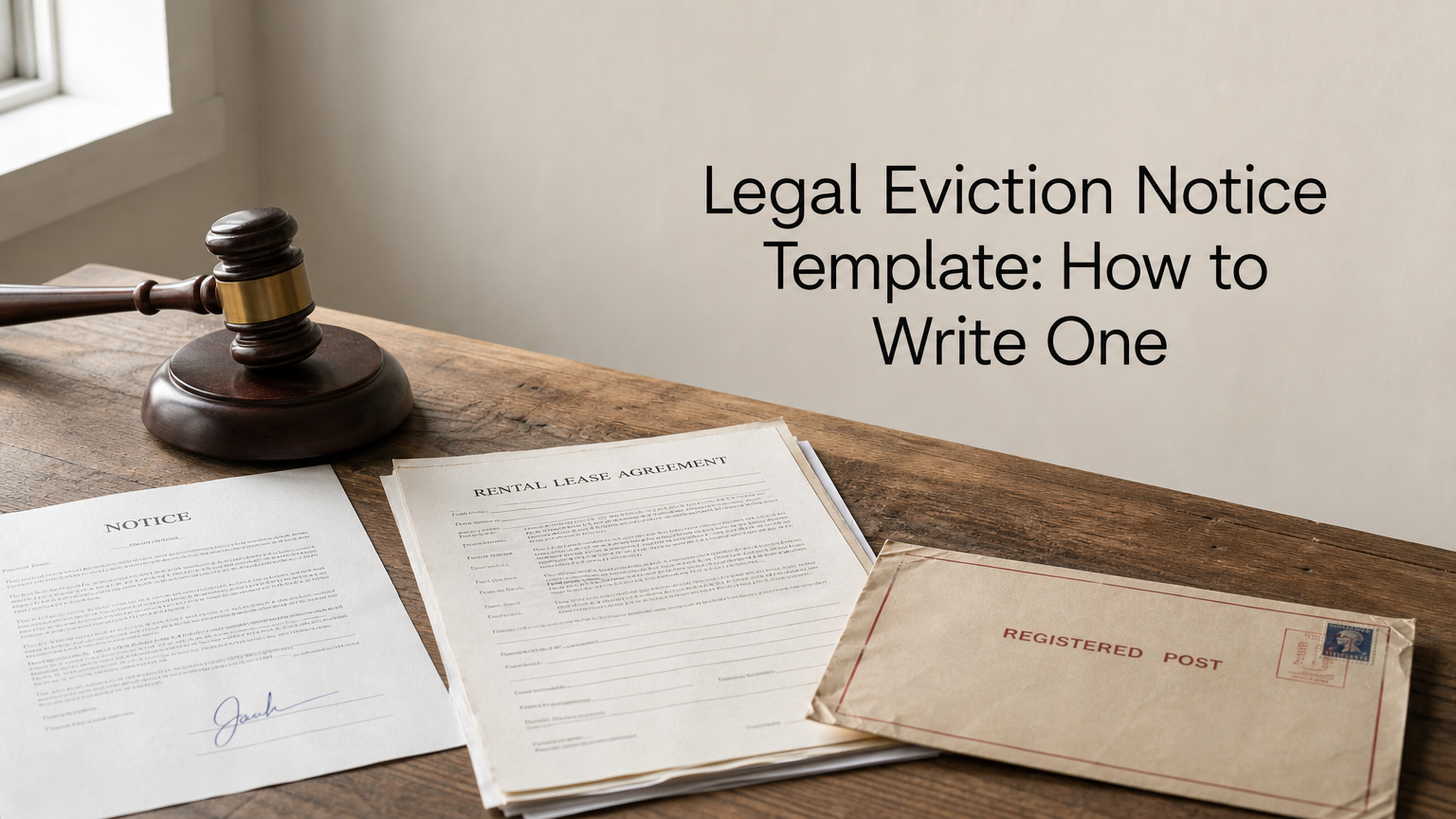
You have a tenant who won’t pay rent or won’t leave, and you need to start the eviction process the right way. Search online for a legal eviction notice template and you will find dozens of generic forms, most written for US or UK law that has nothing to do with how eviction works in Pakistan. Use the wrong wording and a Karachi court can throw your case out before it even starts.
This guide gives you the actual format of legal notice for eviction of tenant that holds up under Pakistani tenancy law, plus the specific clauses, deadlines, and delivery methods that make a notice enforceable rather than just a strongly worded letter. You will see what information is mandatory, what timeline to give the tenant, and how to word the notice so it can’t be challenged on a technicality.
We will walk through the eviction legal notice format section by section, show you a ready-to-use draft you can adapt to your situation, and explain when you actually need an advocate to send it on your behalf. If your tenant already ignored a verbal warning, this is where you start building a paper trail that stands up in court.
What is a legal eviction notice and when do you need one
A legal eviction notice is a formal written warning before court proceedings a landlord sends a tenant stating the grounds for eviction and the deadline to vacate or fix the violation. In Pakistan, this isn’t a courtesy letter. Under the Sindh Rented Premises Ordinance and similar provincial tenancy laws, courts generally won’t accept an eviction suit unless you can prove you gave the tenant proper written notice first. Skip this step, or word it badly, and a judge can dismiss your case outright, forcing you to start over and lose months.
Why the notice has to be formal
Courts treat the notice as your first piece of evidence. It shows the tenant knew about the breach, had a fair chance to respond, and still didn’t comply. Without a documented notice period, you have no paper trail to point to when the case gets contested. That’s why a verbal warning, a text message, or an angry phone call never counts as legal notice, no matter how many times you repeated it.
A tenancy dispute in Pakistan lives or dies on whether your notice was properly written and properly delivered.
When you actually need one
You need a legal eviction notice whenever you’re planning to reclaim the property through the courts rather than by mutual agreement. That includes:
- The tenant has stopped paying rent for one or more months
- The lease term has expired and the tenant refuses to vacate
- You need the property back for personal use (a common ground in Karachi)
- The tenant has sublet without permission or damaged the property
- The tenant is using the premises for a purpose other than what the lease allows
If any of these sound familiar, don’t wait for the situation to escalate on its own. Our landlord-tenant lawyers in Karachi handle eviction cases across the city and can confirm whether your specific situation qualifies before you send anything.
Step 1. Confirm your grounds and notice period
Before you write a single word, pin down the exact legal reason you’re evicting the tenant. Sindh’s tenancy law recognizes specific grounds for eviction, and picking the wrong one, or being vague about it, gives the tenant an easy defense in court. Common grounds include non-payment of rent, expiry of lease, personal bona fide need, unauthorized subletting, and using the property for an illegal or unapproved purpose. Match your notice to the actual breach; don’t stack five reasons hoping one sticks.
Different grounds carry different required notice periods, so check yours against the table below before drafting anything.
| Ground for Eviction | Typical Notice Period |
|---|---|
| Non-payment of rent | 15 to 30 days |
| Lease expiry | 30 days (or per lease terms) |
| Personal use by landlord | 30 to 60 days |
| Illegal subletting or misuse | 15 to 30 days |
Giving too little time is one of the fastest ways to get a case dismissed, so when in doubt, round up. If your lease agreement specifies a longer notice period than the statute requires, honor the lease, since courts will hold you to whichever term is more protective of the tenant.
Once you’ve locked in the ground and the correct notice period, you’re ready to move to the details that go into the notice itself.
Step 2. Gather the tenant and property details
Before you draft anything, pull together the paperwork that proves the tenancy exists and identifies exactly who and what you’re dealing with. A notice that gets the tenant’s name wrong, misstates the address, or can’t be tied back to a signed lease gives the tenant an easy way to argue it doesn’t apply to them.
What to collect
Gather these items before you write a single line:
- Full legal name of the tenant (matching the lease, CNIC, or ID)
- Complete property address, including unit number and any distinguishing details
- Copy of the signed lease or rent agreement, if one exists
- Rent payment history or receipts showing the default, if non-payment is the ground
- Dates of any prior verbal or written communication about the issue
Why accuracy matters here
Even small mismatches, like a slightly different spelling of the tenant’s name, can become the basis for a legal challenge later. Sindh’s tenancy tribunals take these details seriously because they determine whether the notice legally reached the right person about the right property.
A notice built on accurate tenant and property details is far harder for a lawyer to pick apart in court.
Once your file is complete, you have everything you need to move into drafting the actual eviction legal notice format, which is where the specific legal wording comes in.
Step 3. Write the notice using a compliant template
Now you turn your gathered facts into a document with legally correct wording. A compliant eviction notice states the tenant’s name, the property address, the specific ground for eviction, the notice period, and a clear deadline date, not a vague "soon" or "immediately." Skip flowery language. Courts want facts, dates, and a demand, nothing else.
The template
Below is a base structure you can adapt, built on the standard legal notice format used in Karachi. Fill in the bracketed sections with your own details, and don’t remove the reference to the governing law.
[Your Name / Landlord Name]
[Your Address]
Date: [DD/MM/YYYY]

To,
[Tenant's Full Name]
[Property Address]

Subject: Legal Notice for Eviction under Section [X] of the Sindh Rented Premises Ordinance

Dear [Tenant Name],

This is to notify you that you are in breach of the tenancy agreement dated [lease date] on the following ground: [state ground, e.g., non-payment of rent for the months of ___].

You are hereby given [X] days from the receipt of this notice to vacate the premises located at [property address] and hand over vacant possession, failing which legal proceedings will be initiated against you without further notice.

Sincerely,
[Landlord Name / Advocate Name and Seal]
A notice with a specific ground, a firm date, and no vague language is what turns a warning into evidence.
Once drafted, have an advocate review it, or use a professional legal notice drafting service to prepare and send it. Small wording errors here cause bigger delays later.
Step 4. Serve the notice and keep proof of delivery
Writing the notice correctly means nothing if you can’t prove the tenant received it. Karachi courts routinely dismiss eviction suits because the landlord served the notice informally and has no way to demonstrate delivery. Treat this step as seriously as the drafting itself.
How to serve it properly
Send the notice through a method that creates a paper trail:
- Registered post with acknowledgment due (AD)
- Courier service that provides a signed delivery receipt
- Process server or bailiff, arranged through your advocate
- Direct hand delivery witnessed by two people who sign a delivery memo
Avoid relying only on WhatsApp or email unless your lease specifically allows electronic notice, since courts still favor physical proof.
If you can’t prove the tenant received the notice, the court will treat it as if you never sent one.
What to keep on file
Keep every scrap of proof: the postal receipt, courier tracking number, signed acknowledgment, and a copy of the notice itself with the date stamped. Photograph the delivery if you hand-deliver it. Store copies both physically and digitally, since you’ll need to produce them if the case goes to a rent tribunal.
Once delivery is documented, you’re ready to move on to filing a case in Karachi if the tenant still doesn’t comply.
Getting your eviction notice right the first time
A solid legal eviction notice template only works if you match it to the right grounds, fill it with accurate details, and serve it in a way you can prove later. Skip any one of those steps and you hand the tenant an easy defense, one that can cost you months in court and force you to start the whole process over. Get the notice period right, keep your paperwork tight, and treat delivery as seriously as the wording itself.
Before you send anything, remember that every eviction case in Karachi is different. Lease terms, tenant history, and the specific tribunal handling your case all shape what a judge will accept, which is why a property lawyer in Karachi is worth consulting early. Rather than gamble on a generic template, have someone who knows Sindh’s tenancy law review your notice first. Talk to our legal consultants in Karachi before you serve your notice, and start the eviction process with a document that actually holds up in court.